
JUSTA specializes in uncovering the economic and budgetary structures that underpin justice systems, revealing how seemingly technical decisions on financing and management reflect and reinforce social inequalities and broader power dynamics.
This lens has been extended to development agendas, a major source of financing for countries in the Global South, with the goal of bringing the development impacts of incarceration into the global economic agenda through dialogue with International Financial Institutions (IFIs).
Integrating this perspective into financing criteria helps qualify investment decisions in light of existing budget allocation structures and broader development outcomes.
Repositioning incarceration in the development agenda
Multilateral financing and budget allocation in security and justice
matters for development
Repositioning incarceration means recognizing it not only as a criminal justice issue, but also as a development challenge shaped by budget allocations, financial flows and governance structures.
Over the past decade, public security has gained prominence in the agendas of International Financial Institutions (IFIs) as a macroeconomic development variable.
Since 2024, this movement has intensified, with updated economic diagnostics, the creation of a regional alliance, and strengthened programmatic instruments.
This context opens a window of opportunity to integrate incarceration dynamics into the development debate.
In 2023, the global prison population reached 11.7 million people, confirming its structural magnitude (UNODC, Prison Matters 2025).

investments across the
criminal policy cycle
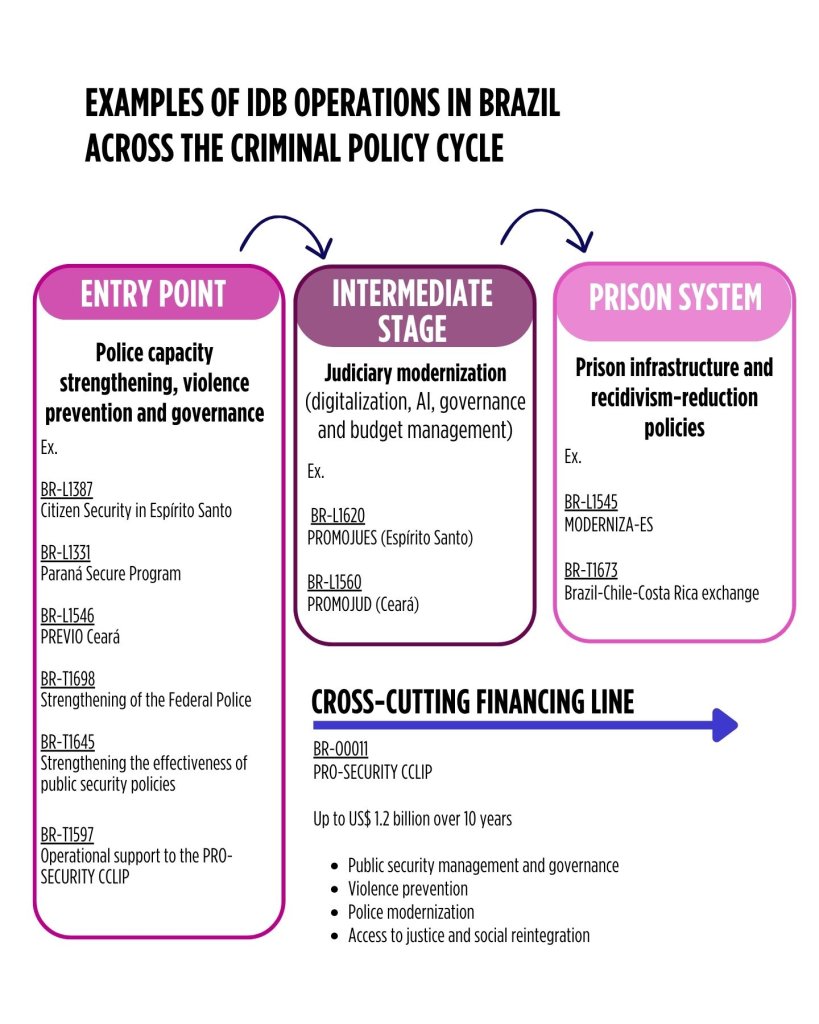
The portfolio of the Inter-American Development Bank (IDB) in Brazil, focused on security and justice projects, illustrates how investments are distributed across different stages of the criminal policy cycle.
Looking at these investments through the lens of the criminal policy cycle helps situate development financing within broader patterns of public budget allocation in the sector.
security and the prison system
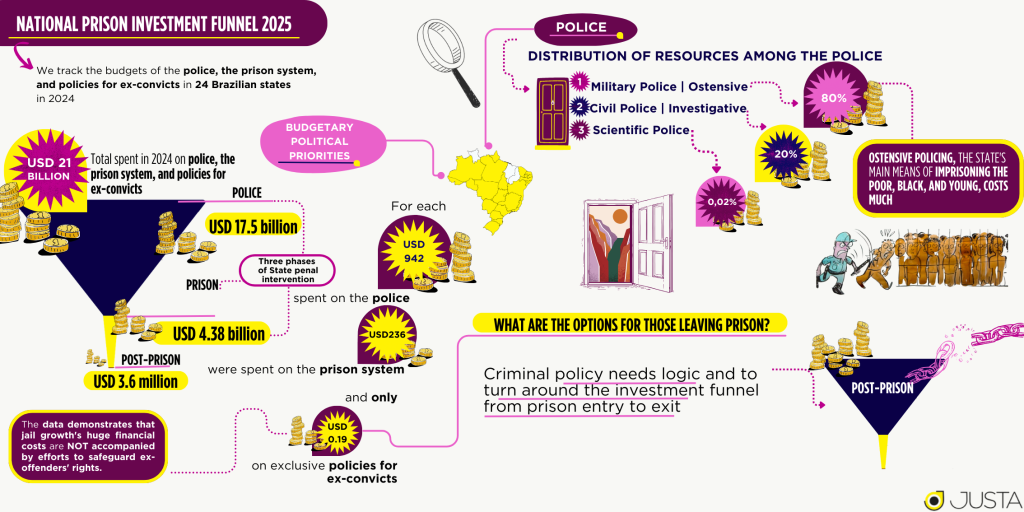
JUSTA’s annual publication Investment funnel in public security and the prison system in Brazil analyzes national budget allocations to policing, the prison system, and reentry policies.
The analysis reveals a budget allocation model that concentrates resources at the entry point of the criminal justice system (policing). At the same time, it sustains investment in a prison system where basic rights violations have been recognized by the Supreme Federal Court, while leaving virtually no opportunities for people leaving prison.


- This allocation pattern also generates significant opportunity costs for the financing of other public policies. São Paulo, the state that spends the most in absolute terms on prison system maintenance, illustrates the scale of this distortion.
- Home to nearly one third of the country’s prison population, São Paulo allocates more resources to maintaining its prison system than to several essential public programs taken together.
- To illustrate this imbalance, JUSTA selected key public spending areas in the State’s budget that, even when combined, do not reach the amount allocated to the prison system.

cycle into project analysis
Projects addressing public security and prison systems should explicitly assess their impact on resource distribution across the criminal policy cycle. The Investment Funnel methodology can complement the evaluation frameworks and development metrics already used by the IFIs.
allocations across the cycle
Financial instruments can encourage more balanced allocations between entry points, prison systems and exit policies, prioritizing prevention, alternatives to incarceration, and reintegration policies, in line with regional diagnostics produced by the IFIs themselves.
aligned with development goals
Initiatives such as Brazil’s Plano Pena Justa (Supreme Federal Court, ADPF 347) can help align prison governance, budget structures and development objectives. Independent monitoring mechanisms involving technical experts, civil society and public institutions can strengthen transparency and improve coordination between planning and financing.
To learn more, explore the summaries below.
To access the full report, click here: https://dados.justa.org.br/
Click on the image to view the full version and access the links